

Condominiumizing a Single Lot in Washington: A Condominiumization Attorney's Roadmap
Last Updated:
5 Minutes
By:
ROI Law Firm
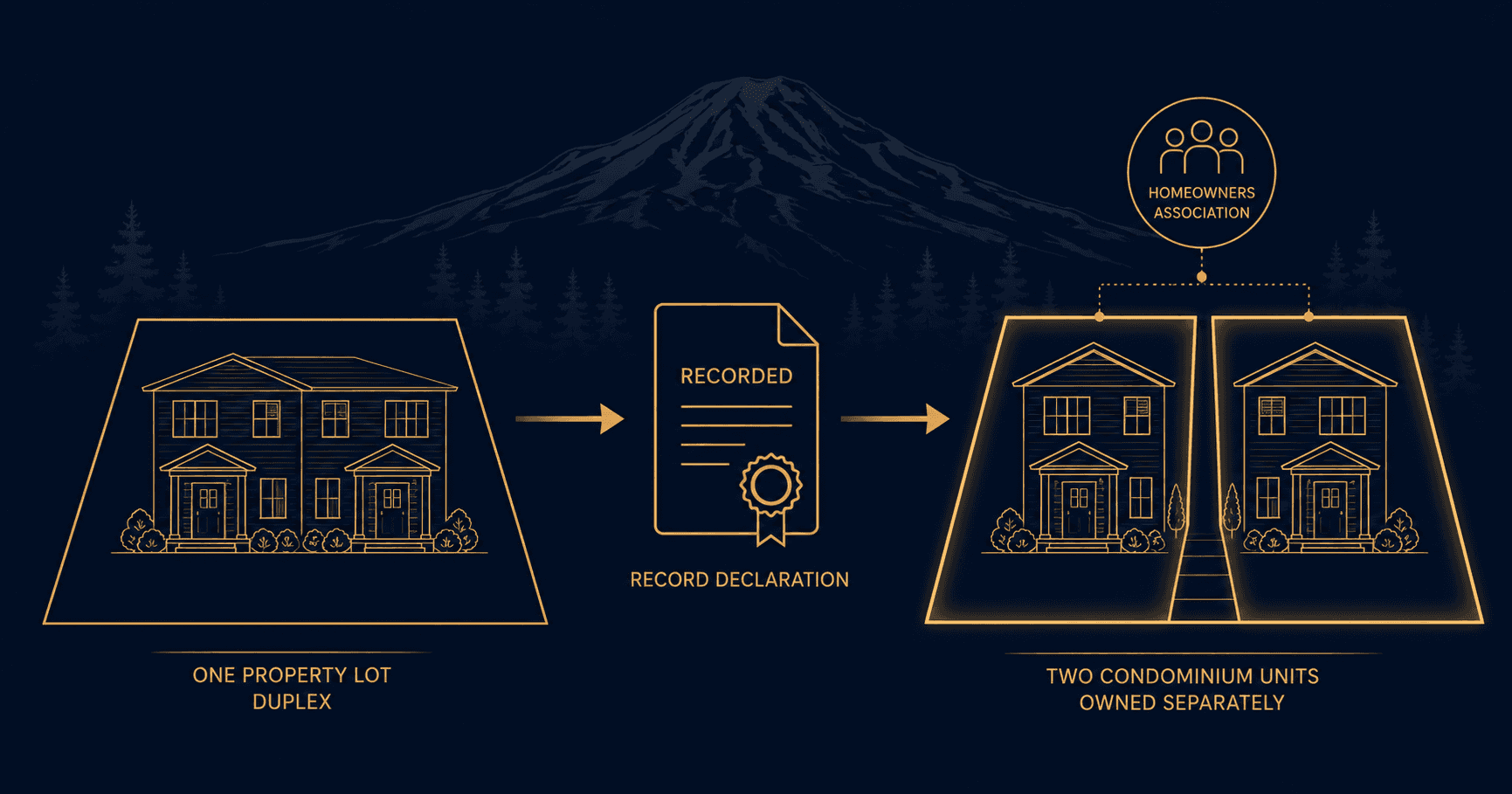
When owners ask a condominiumization attorney how to turn one lot into two or more sellable homes, most expect a surveying answer. It is actually a documents answer. Washington lets you convert a single lot into separately owned units without subdividing the land, but only through a condominium: a recorded declaration and survey map that create units, common elements, and an owners association under the Washington Uniform Common Interest Ownership Act, chapter 64.90 RCW. Done right, each unit gets its own title, its own tax parcel, and its own buyer. Done wrong, nothing on the lot can be sold cleanly at all.
This article walks through what condominiumization is, the documents it requires, and where projects stall. It anchors our condo conversion practice hub.
What condominiumization actually is
A condominium is a form of shared interest ownership. The land stays one legal lot. What gets divided is the ownership: each buyer takes title to a defined unit plus an undivided interest in the common elements, the driveway, the roof, the shared walls, whatever the declaration assigns. That structure is why a duplex, a house plus DADU, or a small new-construction project can produce individually financeable homes without a subdivision. Communities created today fall under chapter 64.90 RCW; older projects may still be governed by the prior Condominium Act, chapter 64.34 RCW. With middle housing laws now allowing more units on single residential lots across Washington, condominiumization has become the standard exit strategy for owners who want to sell those units separately rather than hold them as rentals.
The declaration and survey map: the documents that create the units
Two recorded instruments do the legal work. The declaration is the condominium's constitution: it names the community, defines each unit's boundaries, allocates each unit's share of the common elements, votes, and expenses, sets use restrictions, and establishes the association that will govern the property. The survey map and plans are the graphical half, showing the units, buildings, and common elements with enough precision that a title company can insure a single unit. WUCIOA prescribes the required contents for both, at RCW 64.90.225 for the declaration and RCW 64.90.245 for the map and plans. Recording them is the moment the units legally exist. Before that recording there is one property; after it, there are as many titles as the declaration created.
The package around them matters too: association formation, bylaws, an operating budget, and, for sales to the public, the public offering statement and resale certificate regime WUCIOA imposes on sellers of units.
Myth: "You can split a lot with a quick deed." Every year owners try to sell "the back unit" or "the west half" by quitclaim deed. It does not work. A deed cannot create a unit, and an informal split of one lot runs into Washington's subdivision statute, chapter 58.17 RCW, which voids sales of illegally divided land. What the buyer receives is unmarketable: no legal description that matches a recognized parcel, no title insurance, no lender willing to touch it. The quick deed does not skip the condominiumization process. It just postpones it to the worst possible moment, which is mid-sale.
Local approvals: the city has a say
Recording a declaration does not exempt the project from local review. Cities and counties typically process a single-lot condominium through a binding site plan or similar administrative approval, and the buildings themselves must satisfy building and fire code standards for separately owned dwellings: unit separation, utility metering decisions, addressing, parking. Converting an existing occupied rental building adds another layer, because Washington law gives existing tenants notice and purchase-related rights when their building converts. Local practice varies more here than anywhere else in the process, which is why the approval strategy in Tacoma is not the approval strategy in Bellevue.
Financing and sale: where the structure pays off
The payoff for the paperwork is bankability. Once units exist, each can carry its own deed of trust, which means ordinary residential buyers with ordinary mortgages, a far deeper market than investors buying a whole duplex. Existing construction or acquisition lenders must consent and agree to partial releases so each unit sale pays down its share of the loan. The county assessor splits the tax parcel, escrow closes unit by unit, and the association takes over the common elements per the declaration.
Now the number that makes the point. A Parkland owner finishes a house-plus-DADU project and finds a buyer for the DADU at $415,000. No declaration was ever recorded. Escrow opens, the title company finds one lot and no units, and the sale stops. Preparing and recording the declaration and survey map, forming the association, and clearing lender consent takes four to five months from a standing start. The buyer walks in month two. The owner eventually sells, but one skipped recording froze $415,000 of value for most of a year, and the same defect would have stalled every future unit sale on that lot until fixed.
Common pitfalls we see
The recurring ones: declarations drafted from out-of-state templates that ignore WUCIOA's required contents, unit boundaries that do not match the as-built survey, no lender consent lined up before marketing, budgets and allocations that make the association unworkable at two or three units, missed tenant conversion notices on occupied buildings, and warranty exposure on new construction that nobody priced. Each is cheap to prevent at the drafting table and expensive to litigate afterward. This is transactional work in the same sense as the rest of our documents practice [link to: transactional pillar post], and it overlaps heavily with the land use questions covered in our zoning and permitting guide [link to: land use post].
How this plays out across Western Washington
Pierce County (Tacoma, Parkland, Puyallup, Lakewood): Our home market, and where middle housing infill is producing the most house-plus-DADU condominiumizations. Tacoma's permitting path is workable when the binding site plan and declaration are coordinated early.
Kitsap County (Bremerton, Port Orchard, Poulsbo): Smaller projects, same statutes. Ferry-commute demand makes separately sellable units attractive at price points ordinary buyers can finance.
Eastside King County (Bellevue, Kirkland, Issaquah, Sammamish): The highest-value conversions in the region. At Bellevue land prices, turning one lot into two or three fee-simple-feeling condo homes can add seven figures of combined exit value, and city review is correspondingly exacting.
Snohomish County (Everett, Mill Creek, Lake Stevens): Active infill market with growing DADU volume. The statute is identical statewide; the local approval sequence is what changes.
Your next step: a two-minute self-audit
If you are planning to sell units on a single lot, check four things: a recorded declaration and survey map exist or are budgeted, your lender has agreed in writing to partial releases, the city approval path (binding site plan or equivalent) is identified, and any existing tenants' conversion rights are accounted for. If you are missing even one, the first sale is at risk. Send us your site plan, your title report, or the project as it stands, and we will map the documents and sequence it needs. Book a consultation before the first buyer appears, not after.
Disclaimer: This article is for informational purposes only and does not constitute legal advice or create an attorney-client relationship. For guidance on a specific dwelling unit or tenancy in Washington State, consult a licensed Washington attorney.
Have a question about your property?
Whether it's a notice, a lease, an eviction, or a deal under review, tell us what's going on and a Washington landlord-tenant attorney at ROI Law Firm will get back to you.
Book a consultation →
Tacoma, WA
(253) 753-1530
1302 North I Street, Suite C, Tacoma, WA 98403
© 2025 ROI LAW FIRM. All rights reserved.