

How Long Does the Eviction Process Take in Washington State? A Stage by Stage Timeline
Last Updated:
5 Minutes
By:
ROI Law Firm
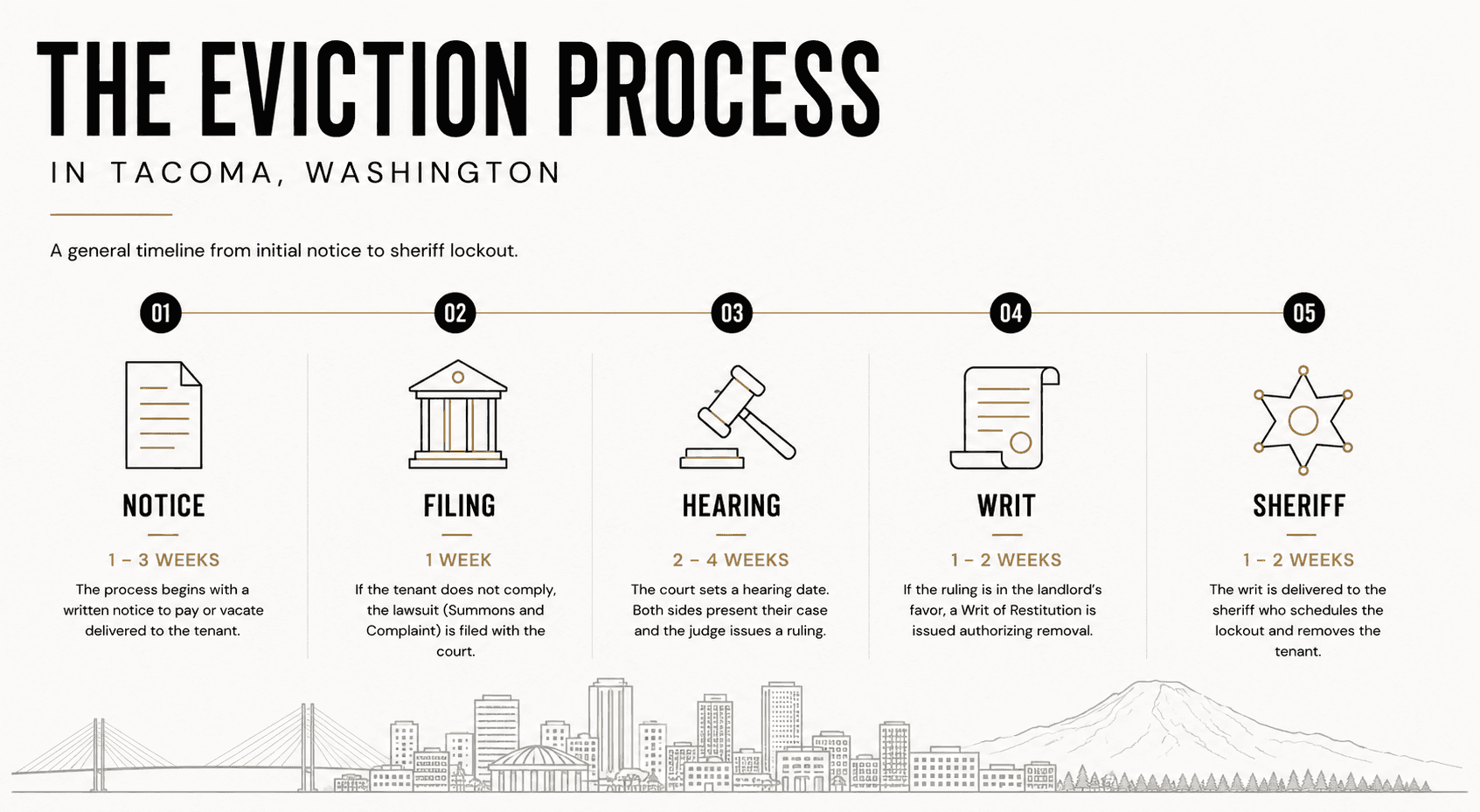
How long does the eviction process take in Washington State? For an uncontested nonpayment case, plan on six to ten weeks from the day the notice is properly served to the day the sheriff restores possession. If the tenant contests the case, or anything in your paperwork is off, three to four months is common. Nobody is out by Friday.
This article is a senior practitioner's walk through the real clock. Washington evictions run through a court process called unlawful detainer under RCW 59.12, and every stage has a statutory minimum that no landlord, attorney, or judge can compress. Understanding those minimums is the difference between a realistic plan and a stalled one. It is also the starting point for our residential eviction practice, where the timeline below is the first thing we map for every new matter.
The timeline at a glance
Notice period: 3 to 90 days depending on the ground. Nonpayment runs 14 days. Some grounds run longer.
Filing and service of the summons and complaint: 1 to 3 weeks. Drafting, filing, and getting the tenant properly served.
Response window and show cause hearing: 2 to 5 weeks. The tenant gets a statutory window to respond, and the court sets the hearing inside another statutory window.
Writ of restitution and the sheriff: 1 to 3 weeks. The writ issues after judgment, and the sheriff's civil unit executes it on its own schedule.
Add those together and the floor for a clean, uncontested nonpayment case is roughly six weeks. The ceiling, when things go sideways, has no fixed number.
Myth: "The judge can have them out by the weekend." This is the single most common expectation new landlord clients bring in, and it is wrong in every Washington county. There is no emergency track that skips the notice, the summons, the hearing, or the sheriff. Changing the locks yourself is not a shortcut either: lockouts, utility shutoffs, and removing a tenant's belongings without a court order are prohibited by RCW 59.18.290 and expose you to damages and attorney's fees. The fastest eviction in Washington is a correctly papered one, not a rushed one.
Stage one: the notice
Every unlawful detainer starts with a written notice, and the notice period is dead time you cannot shorten. For nonpayment of rent, RCW 59.18.057 prescribes a 14-day notice to pay or vacate, with mandatory statutory language. For most other grounds, RCW 59.18.650 sets the cause and the matching notice period: 10 days to comply or vacate for a curable lease violation, 3 days for waste or nuisance, and up to 90 days for certain owner-based grounds such as selling the home or moving in.
The clock only starts when service is done correctly. A notice handed to the wrong person, mailed without the required extra day, or missing statutory language does not start the clock at all. It just feels like it did.
Stage two: filing the unlawful detainer
Once the notice period expires without cure, you can file the unlawful detainer action in superior court. The tenant must then be served with the summons and complaint. Under RCW 59.18.365 the summons gives the tenant a response deadline of not less than 7 and not more than 30 days from service.
Service is where quiet weeks disappear. If the process server cannot find the tenant, you may need multiple attempts or a court order allowing alternative service, and each round adds days. Budget one to three weeks for this stage even when nothing is contested.
Stage three: the show cause hearing
If the tenant responds, the case typically proceeds by a show cause hearing under RCW 59.18.370, set not less than 7 nor more than 30 days out. This is usually the decisive event: the judge or commissioner decides whether you get a writ of restitution now, whether the tenant has a defense worth a full trial, or whether the case resolves by payment or agreement.
Two things routinely stretch this stage. First, court calendars: in busy counties the first available hearing date may already be several weeks out. Second, appointed counsel: indigent tenants have a right to a court-appointed attorney under RCW 59.18.640, and courts will continue a hearing so counsel can appear. A single continuance is two to three weeks in most courts.
Stage four: writ of restitution and the sheriff
Winning the hearing does not put you back in possession. The court authorizes a writ of restitution under RCW 59.18.380, the clerk issues it, and only the county sheriff can execute it under RCW 59.18.390. The sheriff's civil unit serves or posts the writ, gives the tenant a short final window, commonly three to five days, and then schedules the physical eviction. Depending on the county's backlog, this last stage runs one to three weeks. You are on the sheriff's calendar, not your own.
What adds weeks, and what it costs
The predictable delays are worth naming: a defective notice (the case gets dismissed and you restart at stage one), bad service of the summons and complaint, a contested hearing that gets continued for appointed counsel, a tenant who pays late-stage to reinstate the tenancy, a bankruptcy filing that freezes everything, and sheriff scheduling.
Here is the math that matters. Every stalled month is one month of lost rent plus the cost of doing it again. On an $1,800 Tacoma rental, a notice defect discovered at the show cause hearing means roughly $1,800 in additional lost rent while you re-serve and re-file, plus a new filing fee and service costs, call it $400 more. One bad notice is a $2,200 mistake, and we see it weekly.
How this plays out across Western Washington
Pierce County (Tacoma, Lakewood, Puyallup): Our home court. Pierce County Superior Court's show cause calendar moves comparatively well, but Tacoma's Landlord Fairness Code adds local notice requirements on top of state law, and a notice that ignores them restarts the clock.
Kitsap County (Bremerton, Silverdale, Port Orchard): A smaller calendar that can move quickly when papers are clean, though sheriff scheduling for writs can add time in the summer months.
Eastside King County (Bellevue, Kirkland, Issaquah, Renton, Bothell): The busiest docket in the state. Bellevue-area landlords should budget toward the long end of every stage, and expect appointed-counsel continuances as routine.
Snohomish County (Everett, Marysville, Lake Stevens, Mill Creek): Timelines fall between Kitsap and King. Local city ordinances in some Snohomish cities add notice and disclosure layers worth checking before you serve.
Your next step: a two-minute self-audit
If you are holding a notice right now, check four things before you rely on it: the notice matches the actual ground under RCW 59.18.057 or RCW 59.18.650, it contains the required statutory language word for word, it was served by a legally valid method with proof you can show a judge, and the full notice period ran before any filing. If any of those four is uncertain, the cheapest moment to fix it is now, before the filing fee. Send us the notice, the lease, or the whole matter and we will tell you where the clock actually stands. Book a consultation and get a realistic date instead of a hopeful one.
Disclaimer: This article is for informational purposes only and does not constitute legal advice or create an attorney-client relationship. For guidance on a specific dwelling unit or tenancy in Washington State, consult a licensed Washington attorney.
Have a question about your property?
Whether it's a notice, a lease, an eviction, or a deal under review, tell us what's going on and a Washington landlord-tenant attorney at ROI Law Firm will get back to you.
Book a consultation →
Tacoma, WA
(253) 753-1530
1302 North I Street, Suite C, Tacoma, WA 98403
© 2025 ROI LAW FIRM. All rights reserved.