

The HB 1217 Owner-Occupied Exemption: The Documentation Trail Washington Landlords Forget
Last Updated:
4 Minutes
By:
ROI Law Firm
You may qualify to raise rent above the cap. Whether it holds up comes down to the documents behind your notice.
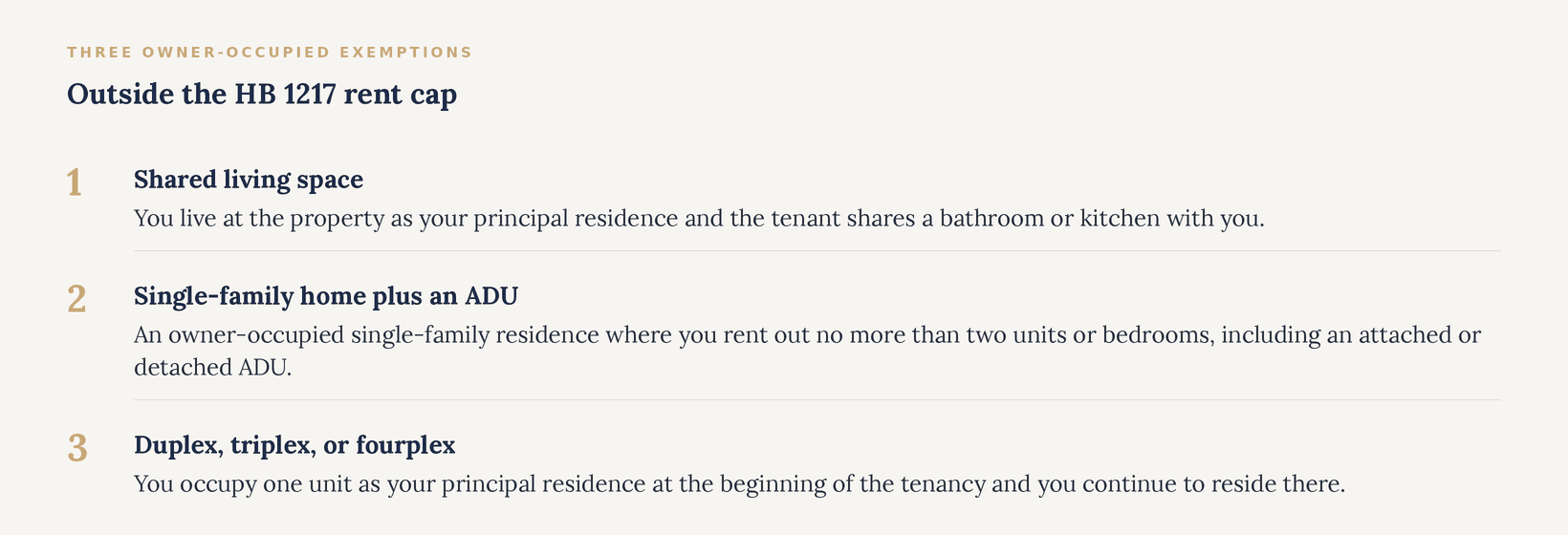
The HB 1217 owner-occupied exemption is one of the few ways a Washington landlord can lawfully raise rent above the statewide rent cap. The catch is that this exemption lives and dies on paper. If you own a duplex, triplex, or fourplex and live in one of the units, you may be exempt from the rent increase limits, but only when your written notice of the rent increase carries the specific facts and documents the statute demands. Skip that step and the Attorney General can treat your raise like any other unlawful rent increase, exemption or not.
We see this gap constantly. The landlord qualifies on the merits and still loses on the record.
What House Bill 1217 actually caps
Under House Bill 1217, Washington state's rent stabilization law, most tenancies are now subject to a rent cap. After the first 12 months, a landlord may raise rent during any 12-month period by no more than 7 percent plus CPI, or 10 percent, whichever is less. For 2026 that ceiling sits at 9.683 percent. The owner-occupied categories sit outside that rent cap entirely.
The carve-out that erases the exemption
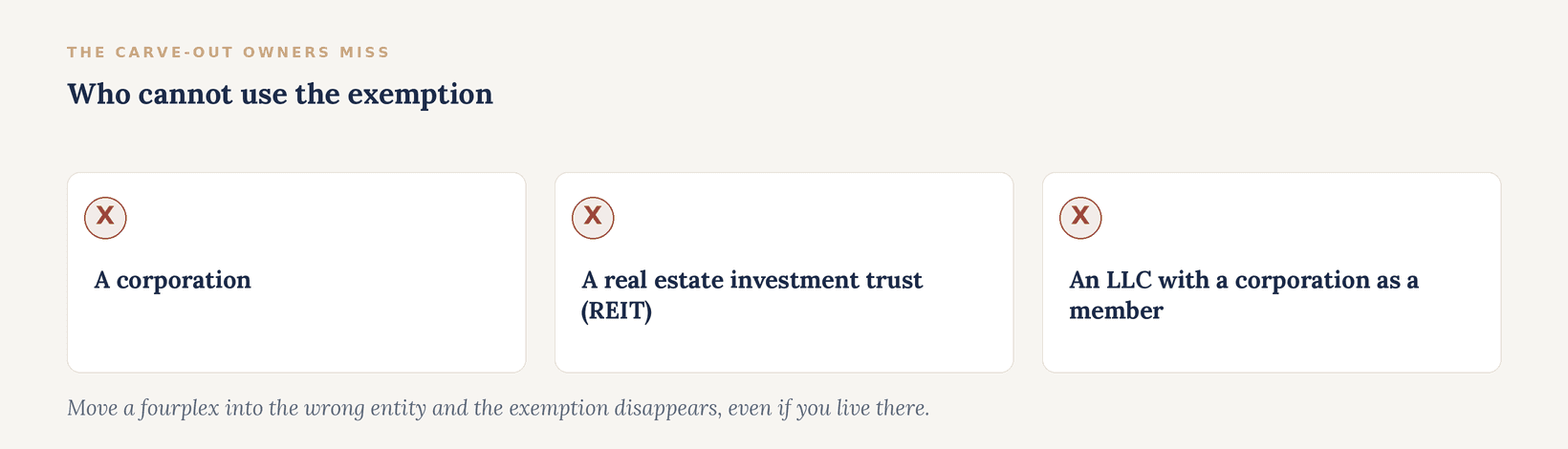
Here is the first place owners trip. The exemption disappears the moment the owner is a real estate investment trust, a corporation, or a limited liability company with at least one corporate member. If you moved your fourplex into an LLC for liability reasons, and a corporation sits anywhere inside that membership, you have likely traded the exemption away without realizing it. The structure that protects your personal assets can quietly forfeit your right to be exempt from the rent increase cap.
The documentation trail everyone forgets
This is the part that costs landlords money. Claiming the exemption is not a checkbox you tick. The statute requires that your notice of the rent increase include specific facts and attach documents supporting the basis for the claimed exemption. The Washington Department of Commerce publishes sample notice language. For the fourplex situation it reads close to this: "You live in a duplex, triplex, or fourplex in which the owner occupied one of the units as the owner's principal place of residence at the beginning of the tenancy, and the owner continues in occupancy." The notice then instructs the landlord to include facts or attach supporting documents.
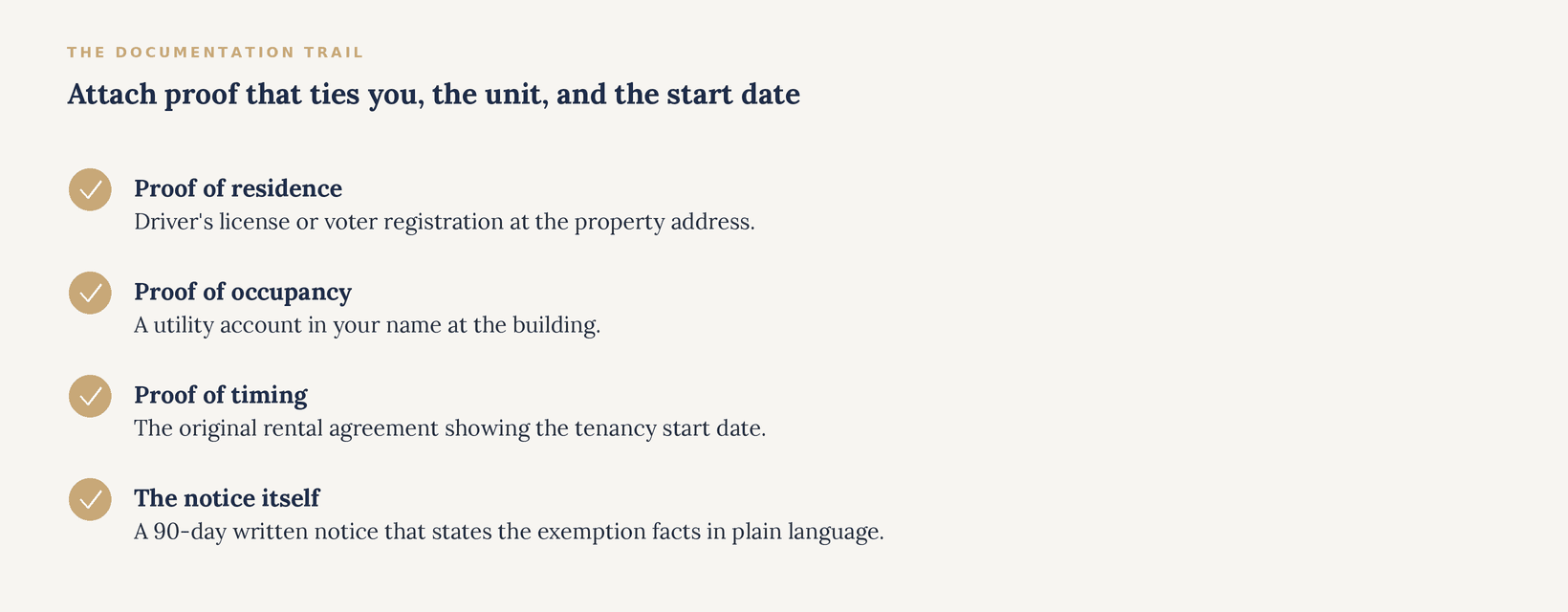
What documents satisfy that? Proof that ties you, the unit, and the start of the tenancy together. Think a driver's license or voter registration at the property address, a utility account in your name at the building, and the original rental agreement showing the tenancy start date. Claiming the exemption with no documentation is treated the same as an unlawful rent increase. The exemption was real; the empty notice is what creates the liability.
And note what does not change. Even when you are exempt from the rent cap, you still owe 90 days' written notice for any rent increase, and the same rules govern fees or other costs charged by the landlord. Exempt from the cap does not mean exempt from notice.
Do not confuse this with the new construction exemption
A separate exemption covers any dwelling unit whose first certificate of occupancy was issued within the last 12 years. If your certificate of occupancy was issued inside that window, the unit is exempt for 12 years from the date occupancy was issued, regardless of who lives there. That is a different track from owner occupancy, and it is separate again from the affordable housing exemptions, which carry their own rules. Mixing these up on a written notice is a common and avoidable error.
Month-to-month, fixed term, and timing
The analysis does not change because your tenant is month to month rather than on a fixed term. What matters is owner occupancy at the beginning of the tenancy, continued occupancy, and your ownership structure. You also cannot rewrite a rental agreement at any time to manufacture the exemption after the fact. The facts are measured from the start of the tenancy forward.
What it costs to get it wrong
Say you own a Bellevue fourplex, live in unit 1, and raise a tenant's rent from $2,400 to $2,750 with a clean 90-day notice but no supporting documents. On the merits you qualified. On the record, you filed an unlawful rent increase.
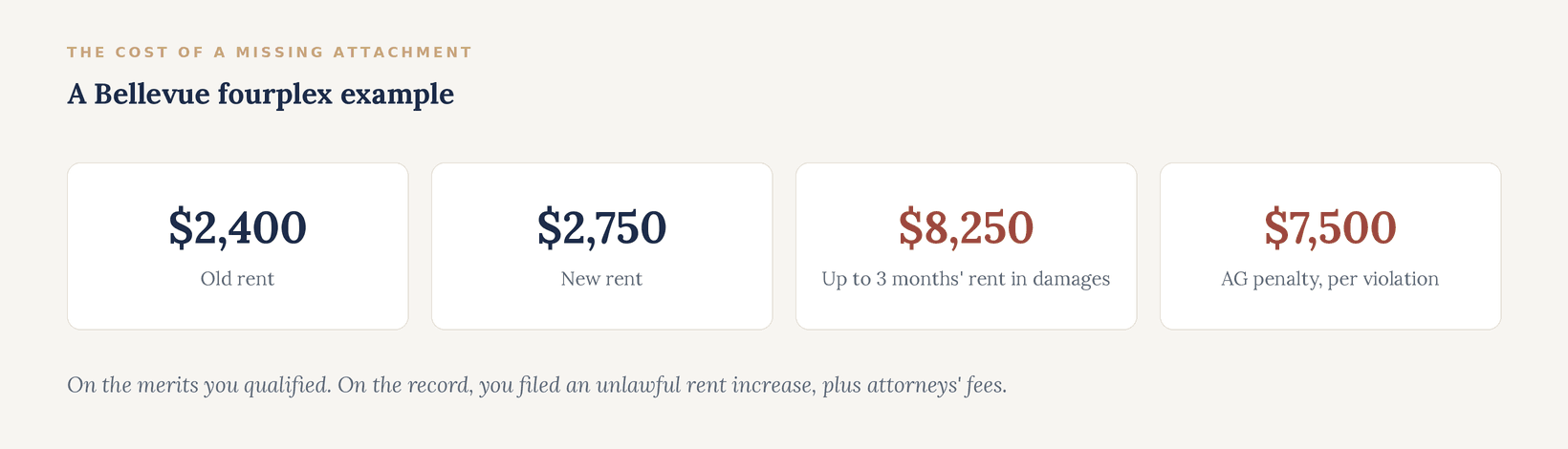
The tenant has a private right of action for actual damages, up to three months' rent, plus attorneys' fees. Three months here is $8,250 before fees, and the Attorney General can pursue up to $7,500 per violation under the Consumer Protection Act. All of that flows from a missing attachment, not a missing right.
Where we work
We handle landlord matters across Washington state, with particular focus on Eastside King County, including Bellevue, Newcastle, Issaquah, Sammamish, and Kirkland. We also serve owners in Snohomish County and Kitsap County. If you own a small owner-occupied building in any of these communities, the exemption can save you real money, but the file has to be built before the notice goes out, not after a tenant challenges it.
A two-minute self-audit before your next notice
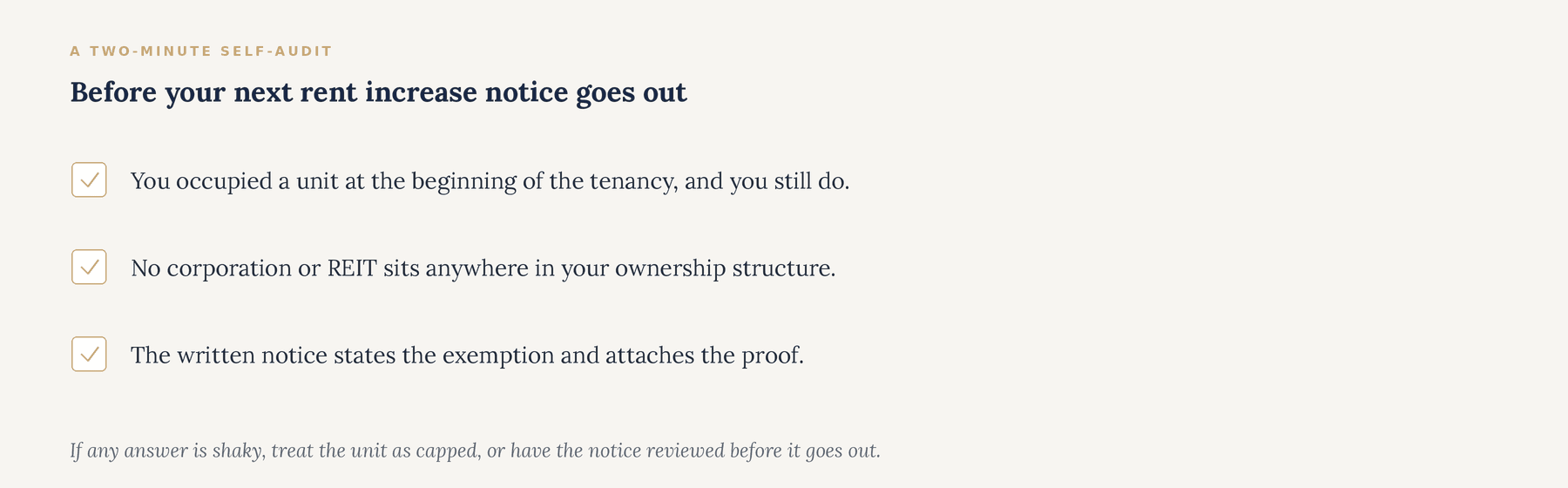
If any answer is shaky, the safer move is to treat the unit as capped, or to have the notice reviewed before it goes out.
Sources: Commerce HB 1217 Landlord Resource Center · Stoel Rives: WA statewide rent control · HB 1217 bill text
Disclaimer: This article is for informational purposes only and does not constitute legal advice or create an attorney-client relationship. For guidance on a specific dwelling unit or tenancy in Washington State, consult a licensed Washington attorney.
Have a question about your property?
Whether it's a notice, a lease, an eviction, or a deal under review, tell us what's going on and a Washington landlord-tenant attorney at ROI Law Firm will get back to you.
Book a consultation →
Tacoma, WA
(253) 753-1530
1302 North I Street, Suite C, Tacoma, WA 98403
© 2025 ROI LAW FIRM. All rights reserved.