
HB 1236 HB 1217 Interaction: How Just Cause and the Rent Cap Actually Work Together
Last Updated:
5 minutes
By:
ROI Law Firm
Two separate statutes, one tenancy. The four places where just cause and the rent cap overlap, and where owners get caught in the seam.
The HB 1236 HB 1217 interaction is where Washington landlords most often get caught. Most coverage treats the two laws as separate stories. One is the just cause eviction law. The other is the rent cap. In practice, they sit on the same tenancy at the same time, and the place owners get caught in the seam between them. A move that looks fine under one statute can be unlawful under the other. As a firm that handles unlawful detainer and transactional work for Washington housing providers, we spend a fair amount of time in that seam. Here is how the two laws actually interact.
The two laws in one sentence each
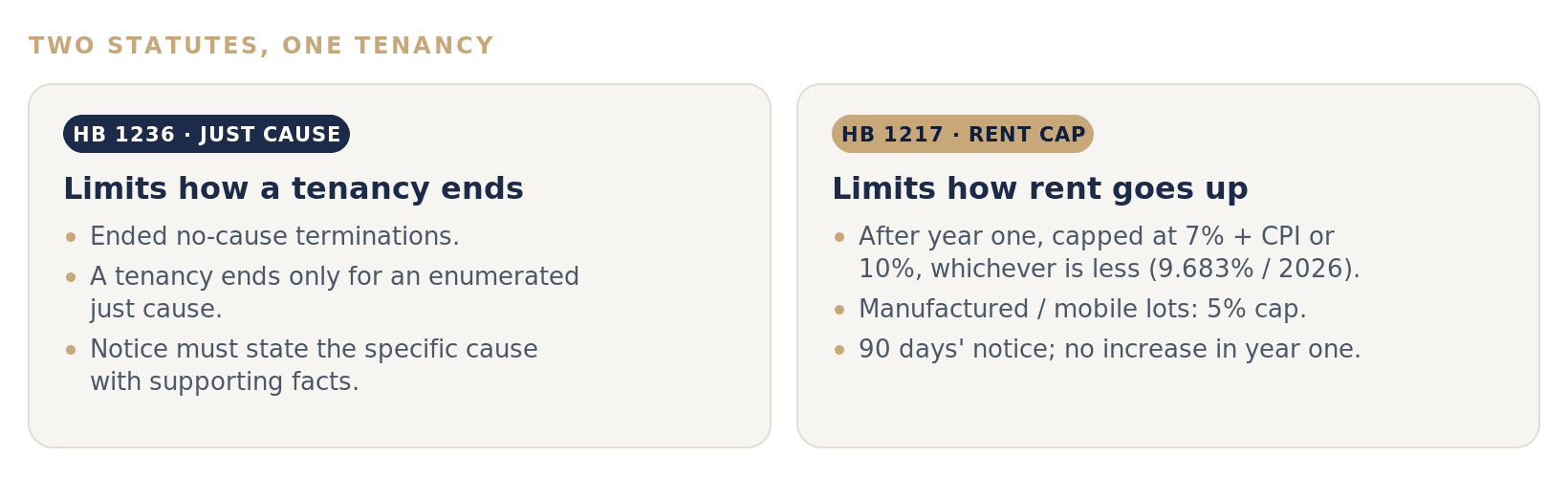
HB 1236, codified in the landlord-tenant act, ended no-cause terminations. A landlord can end a tenancy or decline to renew only for one of the enumerated just causes, and the notice must state the specific cause with enough facts for the tenant to respond. HB 1217 added the rent increase caps: after the first 12 months, the increase in any 12-month period cannot exceed 7% plus the Consumer Price Index for all urban consumers, or 10%, whichever is less, with the Department of Commerce publishing the maximum each year (9.683% for 2026). Manufactured and mobile home lots have a separate 5% cap. Any increase requires at least 90 days' written notice, and no increase is allowed in the first year.
Read alone, each is manageable. Friction arises when a rent decision and a tenancy decision occur simultaneously.
Interaction one: you cannot terminate your way around the cap
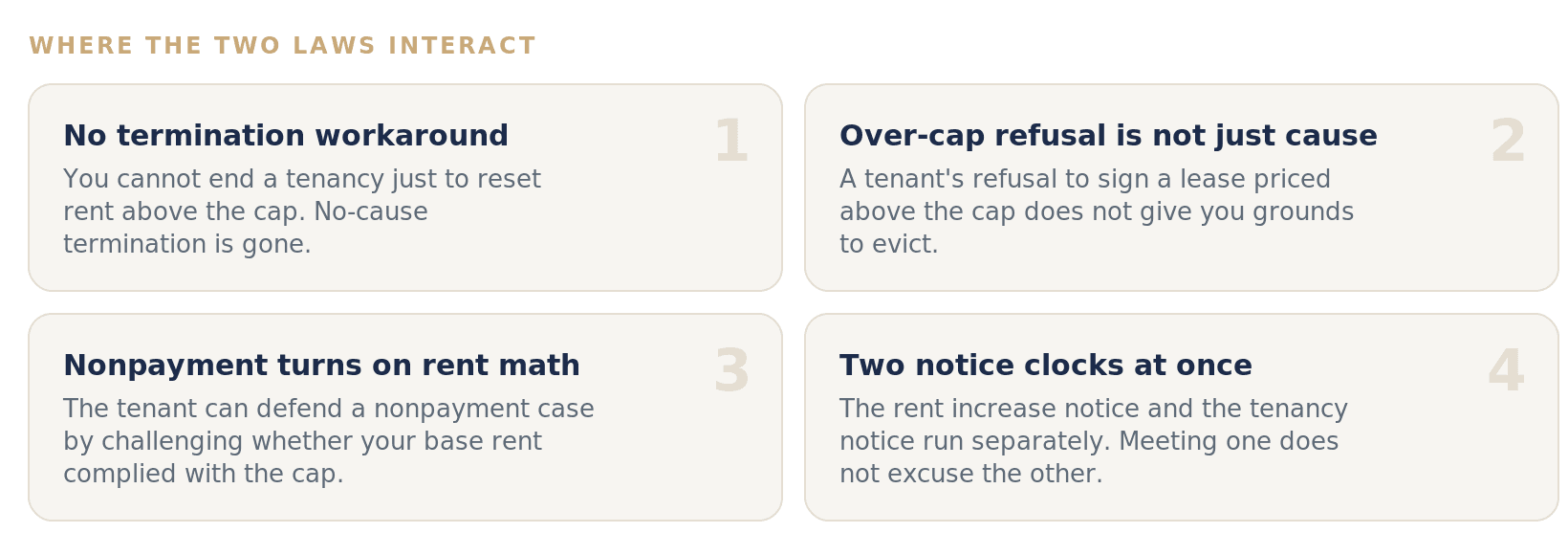
Before HB 1236, a landlord who wanted a large increase could simply end a month-to-month tenancy and re-rent at market. That door is closed. Because no-cause termination is no longer available, you cannot end a tenancy just to raise the rent above what HB 1217 allows. The cap and the just cause rule reinforce each other here. The increase has to fit inside the annual limit, and the tenancy continues unless you have an actual enumerated cause. Trying to use termination as a workaround is the fastest way to turn a rent question into an unlawful detainer problem.
Interaction two: refusal to sign an over-cap lease is not a just cause
This is the interaction we're most often asked about. Under HB 1236, a tenant's refusal to sign a reasonable renewal agreement can support termination of the tenancy. The word that matters is reasonable. If the new lease includes a rent increase that exceeds the HB 1217 cap, the proposed terms are unlawful, and, in our view, a refusal to sign them does not give you a clean just cause. You cannot present an over-cap rent, treat the tenant's "no" as a refusal to renew, and proceed to evict on that basis. The unlawful increase sitting underneath the lease undermines the cause you are relying on. Price the renewal inside the cap first, then the just cause framework works the way it is supposed to.
Interaction three: a nonpayment case can turn on your rent math
Nonpayment of rent is a valid just cause and the most common basis for an unlawful detainer. HB 1217 changes what "the rent" means in that case. If your demand includes an increase that exceeded the cap, was imposed in the first year, or was imposed on short notice, the tenant can challenge the underlying number as a defense. The fight stops being about whether they paid and becomes about whether the amount you charged was lawful in the first place. An increase that is even partly over the cap can put your excess rent fees, attorney's fees, and statutory penalties in play, and can expose you to Attorney General enforcement. Before you file on nonpayment, confirm that the base rent you are suing on complies with HB 1217.
Interaction four: you are running two notice clocks at once
Both statutes impose their own notices, and they do not merge. HB 1217 governs the rent increase notice: it must be in writing, state the new amount, and specify the effective date. HB 1236 governs tenancy notices, including longer notice periods for owner move-in or sale and advance notice to decline renewal of a qualifying term lease. When a single situation involves both a rent change and a change in tenancy, you must satisfy each notice requirement on its own timeline. Meeting one does not excuse the other. If you claim an exemption from the rent cap, be ready to state the specific facts that support it, such as a certificate of occupancy within the exemption window or a qualifying affordable housing designation.
What this means for owners across Washington
We are based in Tacoma and serve Pierce County, and we work with housing providers across the state. Owners in Eastside King County, including Bellevue, Kirkland, Sammamish, Issaquah, and Newcastle, and in Snohomish County and Kitsap County, are managing both statutes on every renewal. Both laws are statewide, so the interaction does not change by county.
The practical takeaway is to decide the rent and the tenancy together, not in separate silos.
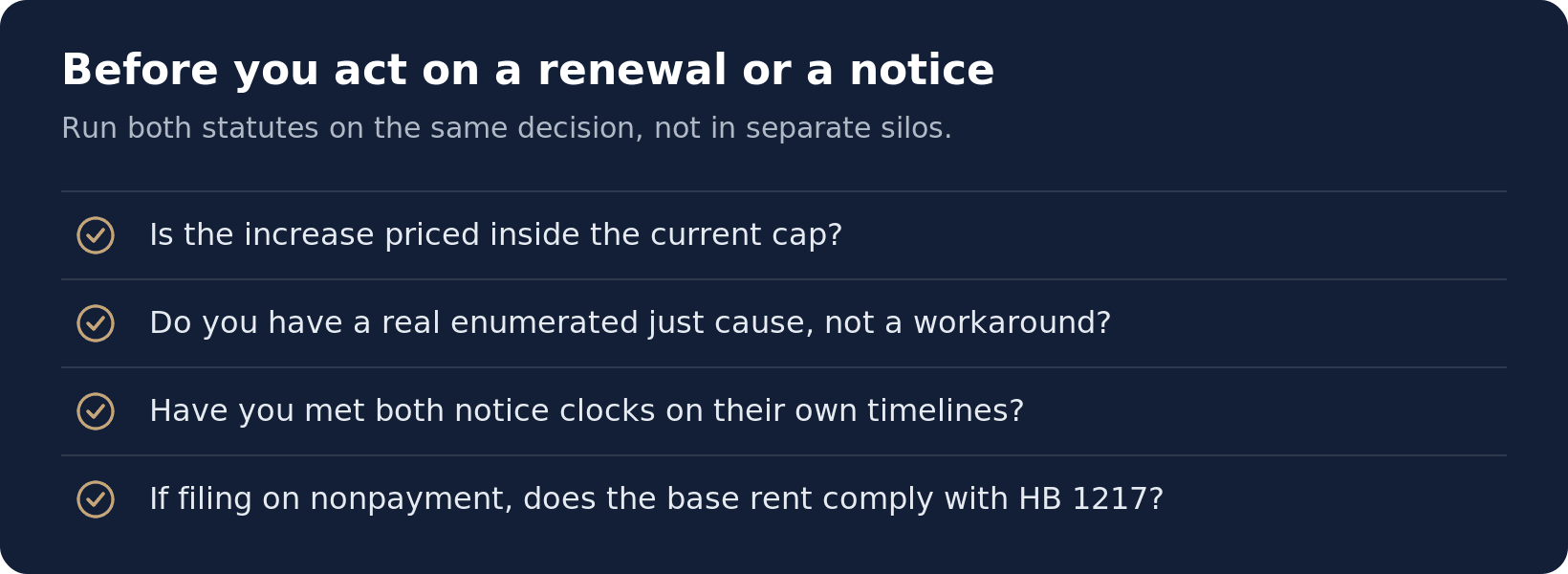
Price the increase inside the cap, give the correct notice for each statute, and confirm you have a real just cause before you act on a renewal or a nonpayment demand. We handle that analysis, along with leases, rental agreements, eviction notices, deeds, easements, seller financing, land use and permitting, condominiumization, and general business counsel for property owners.
Sources: Stoel Rives: WA statewide rent control · RCW 59.18.650 (just cause) · Commerce HB 1217 Landlord Resource Center
Disclaimer: This article is for informational purposes only and does not constitute legal advice or create an attorney-client relationship. For guidance on a specific dwelling unit or tenancy in Washington State, consult a licensed Washington attorney.
Have a question about your property?
Whether it's a notice, a lease, an eviction, or a deal under review, tell us what's going on and a Washington landlord-tenant attorney at ROI Law Firm will get back to you.
Book a consultation →
Tacoma, WA
(253) 753-1530
1302 North I Street, Suite C, Tacoma, WA 98403
© 2025 ROI LAW FIRM. All rights reserved.