
How Many Days Notice for Eviction in Washington State? The 14, 10, and 3-Day Ladder
Last Updated:
7 Minutes
By:
ROI Law Firm
If you are a landlord trying to remove a tenant, the first real question is how many days notice for eviction in Washington state the law actually requires. The answer is not a single number. Washington uses a notice ladder, and the days depend entirely on the reason. Unpaid rent, a lease breach, and serious misconduct each carry a different written notice with a different count. Get the right notice with the right number of days, and your case starts on solid ground. Get it wrong, and the clock resets to zero. This guide walks the three core tiers under RCW 59.18 and RCW 59.12, plus the longer notices for ending a tenancy, so you know exactly which one fits your situation.
Before the tiers, hold on to one rule. The notice is not the eviction. It is the required first step. If the tenant does not comply by the deadline, you still have to file an unlawful detainer action in Superior Court to actually recover possession. You cannot change the locks or remove belongings on your own, no matter how the notice period ends. With that in mind, here is the ladder.
The 14-Day Notice to Pay or Vacate (Unpaid Rent)
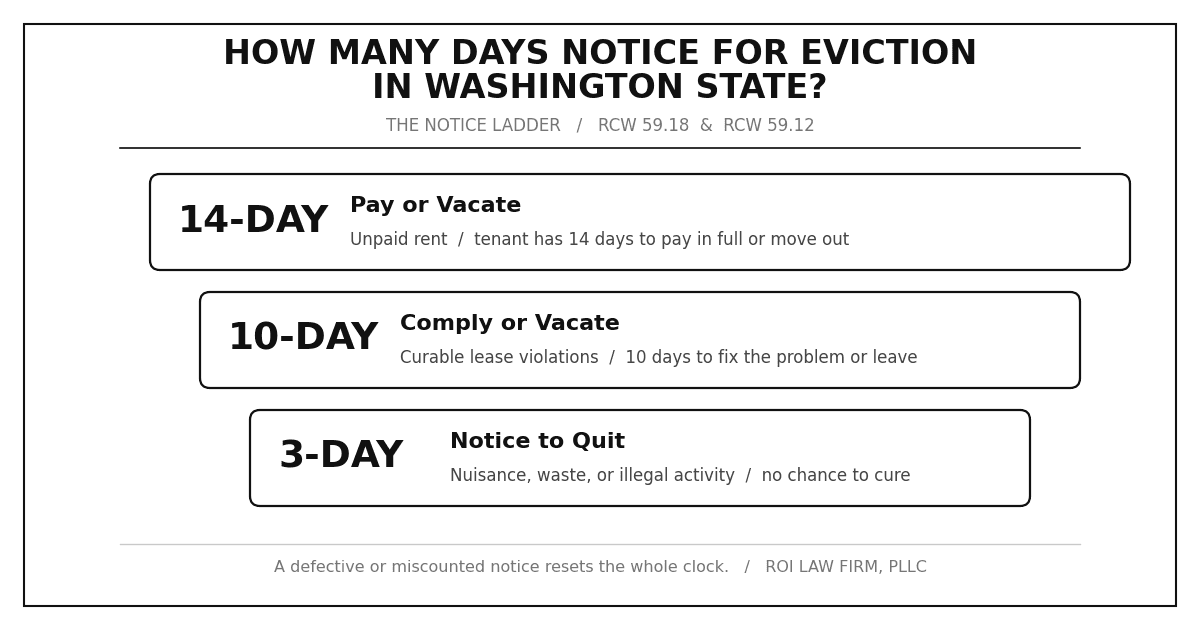
The most common notice in evictions in Washington state is for nonpayment. When a tenant falls behind on the payment of rent, you serve a 14-day notice to pay or vacate. The 14-day notice to pay gives the tenant 14 days to pay the full amount owed or move out. If they pay in full within those 14 days, the tenancy continues and the matter is over.
Two details trip people up here. First, the amount on the notice must be correct and must reflect rent, not a pile of unrelated charges. Courts look closely at this, and an inflated demand can defeat the entire action. Second, the 14 days are counted carefully, and the count usually does not include the day you serve the notice. Miscount the days, and you have served a defective notice.
A quick clarification, because it causes real confusion. Washington does not use a 10-day notice to pay or vacate. Pay-or-vacate is a 14-day notice. The 10-day notice is a different tier for a different problem, covered next. If a template or an online form labels a pay-or-vacate notice as anything other than 14 days, do not use it.
The 10-Day Notice to Comply or Vacate (Lease Violations)
The second tier covers lease violations that the tenant can fix. Common examples include an unauthorized pet, an unapproved occupant, or a maintenance or cleanliness breach. For these, you serve a 10-day notice to comply or vacate. The 10-day notice to comply gives the tenant 10 days either to correct the violation or to move out.
The key word is curable. If the tenant fixes the problem within the 10 days, the violation is cured and the tenancy continues. If the tenant does not comply and does not leave, the notice period has run and you can move to the next stage. As with the 14-day notice, the count and the written description of the violation both matter. A vague notice that does not tell the tenant what they did wrong or how to fix it can fail.
There is also a repeat-violation rule worth knowing. If a tenant racks up four or more 10-day comply-or-vacate notices for similar violations within a 12-month period, the law allows you to issue a longer termination notice rather than offering yet another chance to cure. That is a narrower path, so confirm the requirements before relying on it.
The 3-Day Notice (Nuisance, Waste, or Illegal Activity)
The shortest tier is reserved for the most serious conduct. A 3-day notice applies to nuisance, waste, or certain illegal activity on the property. Unlike the 14-day and 10-day notices, the 3-day notice does not offer a chance to fix the problem, because the conduct itself is the ground. The tenant is being told to leave, not to cure.
Because the 3-day notice is the most aggressive and the most fact-specific, it is also the one most often challenged. What counts as nuisance or waste is a legal question, and a judge may scrutinize whether the conduct truly fits. If you are reaching for a 3-day notice, it is worth getting the facts and the wording reviewed before you serve it, since a failed 3-day notice sends you back to square one.
Notices for Ending a Tenancy Without a Breach
The three tiers above respond to something the tenant did. Ending a tenancy for other reasons follows different counts.
To end a qualifying month to month tenancy, the traditional tool is a 20-day notice to vacate, served at least 20 days before the end of the rental period. Be careful, though. Washington now requires a lawful cause to end most tenancies, so a bare 20 days notice without a permitted reason will not hold up. You cannot simply decide not to renew and assume the 20-day path is open.
For a fixed-term lease longer than six months that you do not intend to renew, the law generally requires at least 60 days written notice before the term ends. And if you are removing tenants to demolish, substantially rehabilitate, or change the use of a building, the notice jumps to at least 120 days. These longer periods exist to give households time to relocate, and skipping them creates the same fatal defect as miscounting a 14-day notice.
One more clarification, since it comes up in searches. Washington does not use a generic 30 days notice for nonpayment of rent. Some states do, but here the pay-or-vacate figure is 14 days. If you are working from a 30-day template you found online, it likely came from another state and does not fit Washington.
Why a Defective or Miscounted Notice Resets the Whole Clock
Here is the part that costs landlords the most money. A notice is the legal foundation of the entire case. If the notice is the wrong type, names the wrong amount, miscounts the days, or is served improperly, the foundation fails. When that happens, you do not get to fix it midstream. You start over with a brand new, correct notice and a brand new notice period. Every defect adds the full count back onto your timeline.
Picture a rental at $2,000 a month. You serve a pay-or-vacate notice, but it lists 10 days instead of 14, and the tenant points that out at the hearing. The judge rules the notice defective, the case is dismissed, and you serve a corrected 14-day notice and refile. You have now lost weeks, often a full extra month or more, which is another $2,000 in rent you will likely never recover, plus a second round of filing and service costs. The notice that felt like a formality turned into the most expensive line item in the case. This is why the count and the wording are not details. They are the case.
Serve It Correctly, Too
Choosing the right notice is only half the job. The notice has to be delivered the right way. Washington prefers personal service, meaning the notice is handed directly to the tenant. If that is not possible after a genuine attempt, the law allows substitute service combined with mailing, and in some situations posting and mailing. Document the date, the time, and the method every time. If a property manager or process server handles delivery, make sure they complete a declaration of service. Improper service is just as fatal as the wrong number of days.
Who We Help
We are based in Tacoma and handle unlawful detainer and ejectment matters throughout Pierce County, including Tacoma, Puyallup, Lakewood, University Place, and Gig Harbor. We also serve owners in Snohomish County, Kitsap County, and Eastside King County, including Bellevue, Newcastle, Issaquah, Sammamish, and Kirkland. Bellevue owners are especially welcome to reach out.
Beyond eviction work, we handle the transactional matters property owners rely on: eviction notices, leases, deeds, easements, seller financing documents, feasibility and permitting, land use, condominiumization, and business counsel.
Run a Quick Self-Audit on Your Notice
Before you serve anything, put your template through a short check. Does the notice match the reason: a 14-day notice to pay for unpaid rent, a 10-day notice to comply for a curable lease breach, or a 3-day notice for nuisance, waste, or illegal activity? Is the day count correct and counted properly? Is the dollar amount exact and limited to rent? Does it clearly state what the tenant must do and by when? And do you have a plan to serve it properly and document service? If you cannot answer yes to each, fixing it now is far cheaper than a dismissed case later.
If you want a second set of eyes on a notice before you serve it, send it over for a review. For the bigger picture, see our companion guides on the full eviction steps and on how long the eviction timeline really takes.

Disclaimer: This article is for informational purposes only and does not constitute legal advice or create an attorney-client relationship. For guidance on a specific dwelling unit or tenancy in Washington State, consult a licensed Washington attorney.
Have a question about your property?
Whether it's a notice, a lease, an eviction, or a deal under review, tell us what's going on and a Washington landlord-tenant attorney at ROI Law Firm will get back to you.
Book a consultation →
Tacoma, WA
(253) 753-1530
1302 North I Street, Suite C, Tacoma, WA 98403
© 2025 ROI LAW FIRM. All rights reserved.