
How to Evict a Tenant in Washington State: A Step-by-Step Legal Guide
Last Updated:
8 Minutes
By:
ROI Law Firm
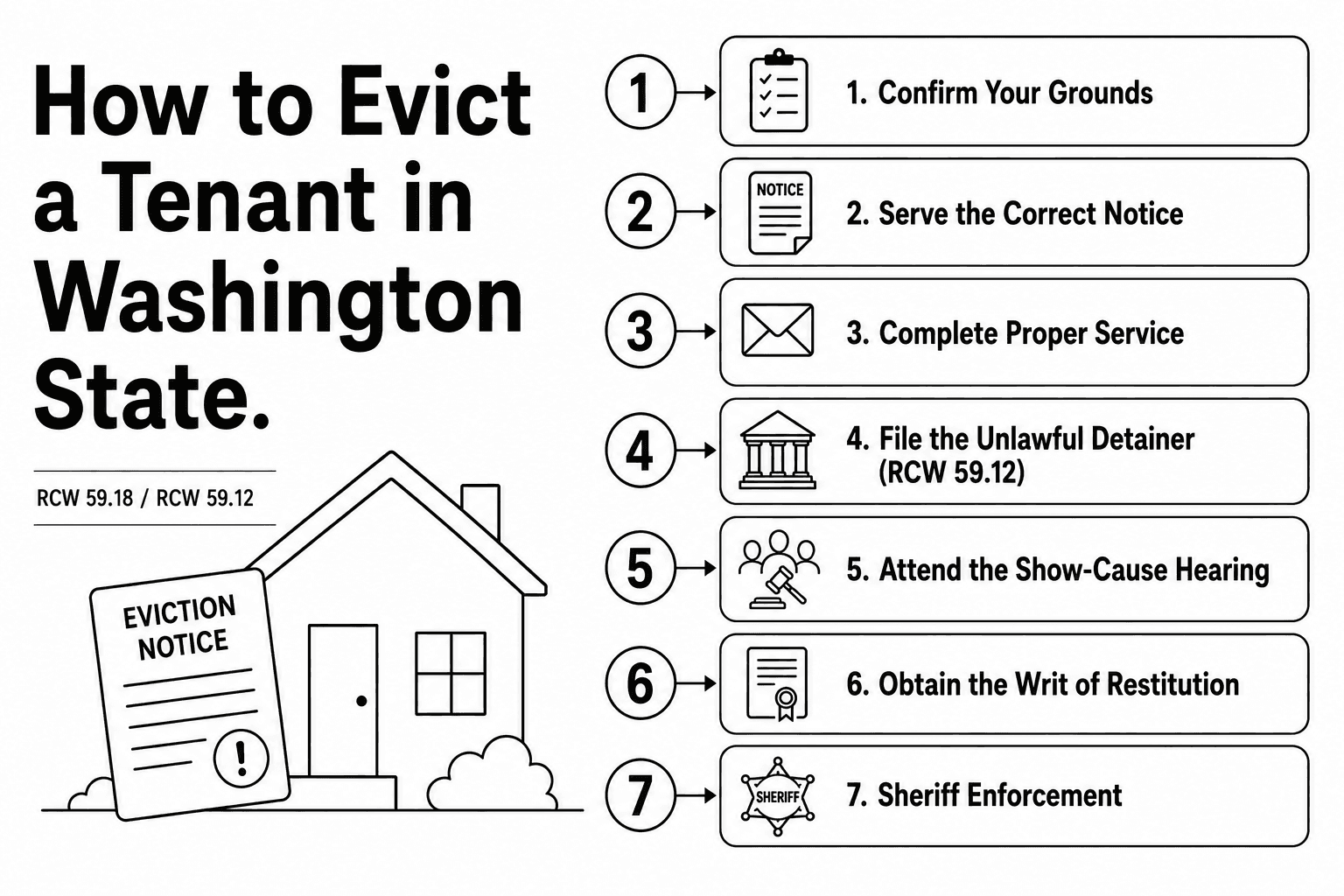
If you own rental property and need to remove a tenant, the most important thing to understand is this: how to evict a tenant in Washington state is a court process, not a personal decision you can carry out yourself. Washington law sets out one lawful path through the Residential Landlord-Tenant Act (RCW 59.18) and the unlawful detainer statute (RCW 59.12), and skipping a step usually means starting over. This guide walks the full sequence, from the first written notice to the sheriff's writ, so you can move forward without handing the tenant a defense.
Before we start, one point that cannot be repeated enough. You may not change the locks, shut off utilities, remove the tenant's belongings, or do anything else to force a tenant out on your own. Those are called self-help evictions, and they are illegal in Washington. They can expose you to the tenant's actual damages plus additional penalties, so the few weeks you think you are saving can turn into a far larger bill. The only person who can physically remove a tenant is the county sheriff, acting on a court order. With that settled, here are the steps.
Step 1: Confirm Your Grounds and Review the Lease
Every lawful eviction starts with a valid reason. The most common ground is nonpayment of rent. Other grounds include lease violations, such as unauthorized occupants, pets in a no-pet unit, or property damage, and serious conduct like waste or nuisance. Washington also limits when you can end a tenancy without cause, so do not assume you can simply decide not to renew.
Pull out your lease agreements and read them closely. What does the lease say about the payment of rent, late fees, and cure periods? Is the tenant on a fixed term or a month to month tenancy? Is there a property manager in the chain who handled prior notices? The answers shape which notice you serve and how much time you must give. The eviction process in Washington state rewards landlords who get this groundwork right and punishes those who guess.
Step 2: Serve the Correct Written Notice
This is the step where most cases are won or lost. Washington requires a specific written notice for each situation, and the notice type and timeline must match the reason. Use the wrong form or the wrong number of days, and a judge can dismiss the case.
For nonpayment of rent, you serve a 14-day notice to pay or vacate. The 14-day notice to pay gives the tenant 14 days to pay the full amount owed or move out. The notice must state the amount due correctly. An inflated figure, or one that bundles in fees that do not belong, can sink the whole action.
For curable lease violations, you serve a 10-day notice to comply or vacate. The 10-day notice to comply gives the tenant 10 days to fix the problem, such as removing an unauthorized pet, or to leave. If the tenant cures within the window, the matter ends there.
For serious, non-curable conduct such as nuisance, waste, or certain illegal activity, you may serve a 3-day notice to quit. The 3-day notice does not offer a chance to fix the issue because the conduct itself is the ground.
For ending a qualifying month to month tenancy, a 20-day notice to vacate is the traditional tool, but be careful here. Washington now requires a lawful cause to end most tenancies, so a simple 20 days notice without a permitted reason will not hold up. Confirm that your reason fits one of the allowed categories before you rely on the 20-day path.
Keep in mind that rent increases follow their own separate rules and are not an eviction tool. Statewide law now caps annual increases and requires longer advance notice, so never try to force a tenant out by raising the rent. If your goal is removal, use the correct notice for the actual ground.
Step 3: Complete Proper Service of the Notice
Serving the right notice the wrong way is just as fatal as serving the wrong notice. Washington prefers personal service, meaning the notice is handed directly to the tenant. If personal service is not possible after a genuine attempt, the law allows substitute service on a person of suitable age at the residence combined with mailing, and in some situations posting and mailing. Document every attempt: the date, the time, who served it, and how. That record becomes your proof if the tenant later claims they never received it.
If a process server or your property manager handles service, make sure they understand the rules and complete a declaration of service. Courts take service seriously, and a sloppy or undocumented attempt is one of the easiest ways for a tenant to delay or defeat an otherwise valid case.
Step 4: File the Unlawful Detainer Action
If the notice period expires and the tenant has not paid, cured, or moved, you may begin the lawsuit. In Washington, the eviction lawsuit is called an unlawful detainer action, and you file it in the Superior Court of the county where the property sits. For a Pierce County rental, that means Pierce County Superior Court.
You prepare and file a summons and complaint. The summons tells the tenant how long they have to respond, and the complaint states your grounds and asks the court to restore possession of the property to you. The summons and complaint must be served on the tenant under the same careful service rules described above, often by personal service. The tenant then has a defined window, in many cases up to 20 days depending on how the matter proceeds, to file a written answer with the court. If the tenant does not respond, you may be able to seek a default judgment without a contested court hearing.
Step 5: Attend the Show-Cause Hearing
When a tenant responds or the court sets the matter for review, the next stage is usually a show-cause hearing. This is the court hearing where both sides appear and the judge decides whether you are entitled to possession now or whether the case needs a full trial. The court sets this hearing on a tight statutory window, generally not less than 7 nor more than 30 days after service.
Come prepared. Bring the lease, your ledger showing the payment of rent history, copies of the notice, and your proof of service. The judge rules based on the record and the law, not on how frustrating the situation has been. If the documents line up and the tenant has no valid defense, the court can grant you possession at this hearing. If the tenant raises a genuine factual dispute, the judge may set the matter for trial, which adds time. This is exactly why the early steps matter so much.
Step 6: Obtain the Court Order and Writ of Restitution
If you prevail, the court enters a judgment and issues a court order for possession along with a writ of restitution. The writ of restitution is the document that authorizes the sheriff to remove the tenant. It is the legal key to the door, and you cannot act without it.
In a nonpayment case, Washington gives the tenant a short window after judgment, typically five days, to pay the full judgment amount plus costs and keep the unit. Plan for that pause and do not assume the writ executes the instant the judge rules.
Step 7: Sheriff Enforcement
The final step belongs to the county sheriff. You deliver the writ of restitution to the sheriff's office, and the sheriff serves or posts it on the property. Washington law builds in a waiting period, so the sheriff generally cannot execute the writ for at least three days after service. If the tenant has not left by the deadline, the sheriff returns to oversee the physical removal and the securing of the property. In busier counties, scheduling that final visit can add more days on top of the statutory wait.
Only the sheriff performs this step. Returning to the warning at the top, never take matters into your own hands once you have a writ. Let the sheriff do the work, and your judgment stays clean.
Why Self-Help Lockouts Are a Costly Mistake
It is worth stating again because the temptation is real. Changing the locks, removing doors, hauling belongings to the curb, or cutting off heat and water are all illegal ways to evict a tenant in Washington. A tenant who is locked out unlawfully can sue, recover damages, and in some cases collect penalties on top. Owners who try the fast route often end up paying more than the unpaid rent they were chasing. The lawful path is slower, but it protects your property, your judgment, and your wallet.
Serving Property Owners Across Pierce County and Beyond
We are based in Tacoma and handle unlawful detainer and ejectment matters throughout the region. In Pierce County, we regularly assist owners in Tacoma, Puyallup, Lakewood, University Place, Gig Harbor, and the surrounding communities. We also serve clients in Snohomish County, Kitsap County, and Eastside King County, including Bellevue, Newcastle, Issaquah, Sammamish, and Kirkland. Bellevue owners in particular are welcome to reach out.
Alongside eviction work, we handle the transactional matters that property owners rely on: eviction notices, leases, deeds, easements, seller financing documents, feasibility and permitting, land use, condominiumization, and business counsel.
Run a Quick Self-Audit Before You File
Before you spend a dollar on filing, take five minutes and check your foundation. Is your ground for eviction valid and documented? Did you choose the correct notice, the 14-day notice to pay, the 10-day notice to comply, the 3-day notice to quit, or a lawful 20-day notice? Is the dollar amount exact? Was the notice served properly, with a record of how and when? If you cannot answer yes to each of these, fixing the problem now is far cheaper than losing the case later and starting over.
If you want a second set of eyes on a notice before you file, send it over for a review. For more detail, see our companion guides on Washington notice rules and on how long the eviction timeline really takes.
Disclaimer: This article is for informational purposes only and does not constitute legal advice or create an attorney-client relationship. For guidance on a specific dwelling unit or tenancy in Washington State, consult a licensed Washington attorney.
Have a question about your property?
Whether it's a notice, a lease, an eviction, or a deal under review, tell us what's going on and a Washington landlord-tenant attorney at ROI Law Firm will get back to you.
Book a consultation →
Tacoma, WA
(253) 753-1530
1302 North I Street, Suite C, Tacoma, WA 98403
© 2025 ROI LAW FIRM. All rights reserved.